TL;DR
A wake window is the time between the end of one sleep and the start of the next. It includes the feed, the diaper change, the play, the fussing, and the wind-down. It is not "awake time minus feeding." Babies have a limited tolerance for being awake before stress hormones climb, and once they climb, falling asleep gets harder, not easier. That is the whole reason windows exist: to get the baby down before the second wind.
One honest caveat. The American Academy of Pediatrics and the American Academy of Sleep Medicine publish total sleep needs by age1,2, not wake windows. Windows are the practical framework sleep consultants and pediatric nurses use to hit those totals, and the ranges below are what that practice converges on. Your baby will sit somewhere in the range, and the range itself shifts earlier in the day and later toward bedtime.
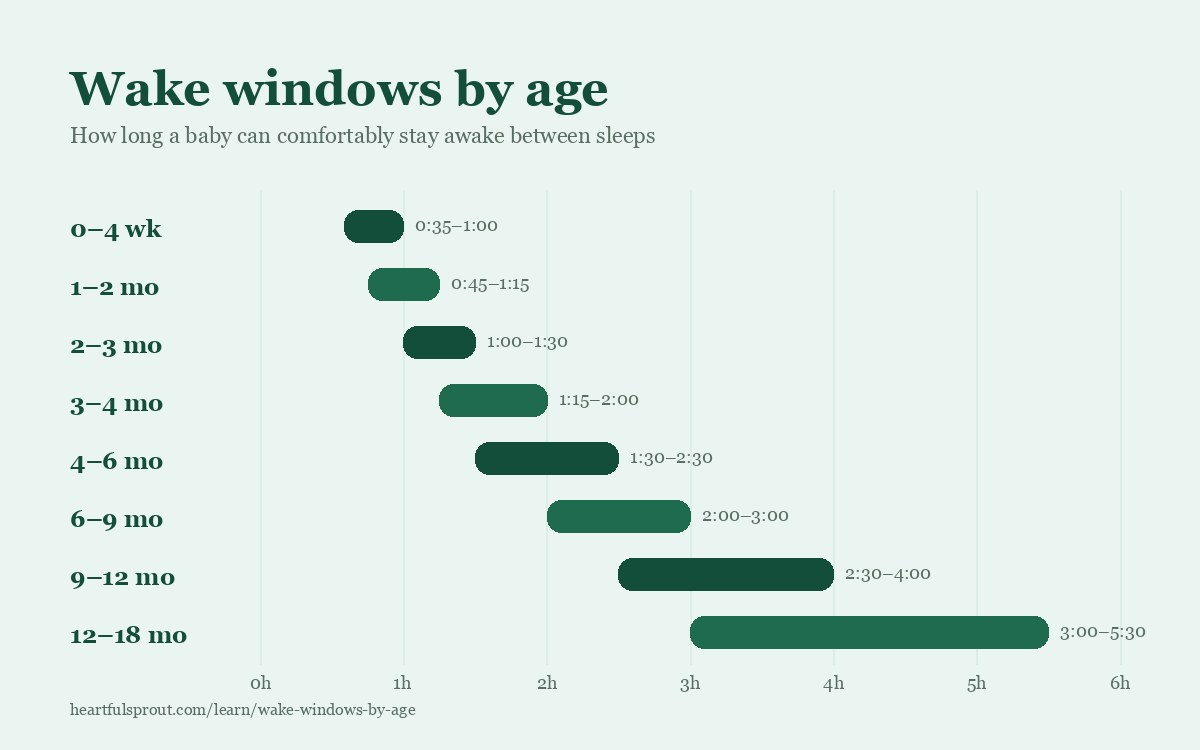
| Age | Wake window | Naps per day | Total sleep in 24h |
|---|---|---|---|
| 0 to 4 weeks | 35 to 60 min | 5 to 8, irregular | 14 to 17 h2 |
| 1 to 2 months | 45 to 75 min | 4 to 6 | 14 to 17 h |
| 2 to 3 months | 60 to 90 min | 4 to 5 | 14 to 16 h |
| 3 to 4 months | 75 min to 2 h | 3 to 4 | 13 to 16 h |
| 4 to 6 months | 1.5 to 2.5 h | 3 to 4 | 12 to 16 h |
| 6 to 9 months | 2 to 3 h | 2 to 3 | 12 to 15 h |
| 9 to 12 months | 2.5 to 4 h | 2 | 12 to 15 h |
| 12 to 18 months | 3 to 5.5 h | 1 to 2 | 11 to 14 h |
Two rules make the chart useful. First, the earliest window is the shortest: a 6-month-old might manage 2 hours after waking in the morning and 3 hours before bed. Second, short naps shorten the next window. A 30-minute nap does not reset the clock the way a 90-minute one does.
Forget schedules. Feed, change, a few minutes of eye contact, and your baby is ready to sleep again. Many newborns are overtired by 45 minutes. If they are fussy at the hour mark, you are already late. Day and night are not yet distinguished; a circadian rhythm with nighttime melatonin emerges over the first two to three months3.
Windows stretch past an hour. A loose rhythm appears: wake, feed, play, nap, repeat four or five times. The 4-month sleep regression is really sleep maturing: your baby now cycles through light and deep sleep like an adult and wakes between cycles. Protecting the window helps more than anything else during this stretch.
Three naps settle in, roughly at 9, 12, and 3, with a short catnap sometimes added late in the day. Bedtime can move earlier (6:30 to 7:30 is common) once the last nap ends by 4 or so. Solids start in this stage for many babies, which is a good reason to log feeds and sleep together.
The late catnap drops first, then the day settles into two solid naps with 2 to 3 hour windows. Separation anxiety and crawling can both disrupt sleep around 8 to 9 months; the window usually still holds even when the nap itself is a fight.
Two naps, windows approaching 3 to 4 hours. Some babies fake a nap transition around 10 months: a few days of refusing the second nap, then back to two. Hold the two-nap schedule until the refusal lasts two weeks.
The two-to-one nap transition usually lands between 13 and 18 months. The single nap moves to midday, windows stretch to 5 or more hours, and bedtime may need to come earlier for a few weeks while the body adjusts.
The window tells you when to start watching. The cues tell you when to move.
A baby showing late cues is not "not tired." They are past tired. Dim the room, reduce stimulation, and expect it to take longer. Then shorten the next window by 15 minutes.
The Heartful Baby app does the first step automatically: log sleep, and it computes your baby's own wake windows and predicts the next nap, with a lock-screen countdown so neither parent has to do the math. We compared it against the other baby tracker apps for two parents if you want options.
Share this with your care team
Your pediatrician, doula, night nurse, or lactation consultant sees your baby for minutes a week; you see every feed and nap. Heartful Baby was built so they can see what you see. Ask whether they use Heartful Sprout, and if not, send them to heartfulsprout.com/clinicians. We make it easy for clinicians who reach out to get set up with their families.
This article is for general education and isn't a substitute for individual medical advice. For guidance specific to your baby, talk with your pediatrician.
Log sleep in a tap. The next nap shows on your lock screen.
See Heartful Baby